
There is a particular kind of pressure that follows people into adulthood, then intensifies as they become more senior.
It is the pressure to have it figured out.
Not just to make decisions. To look like you know. To sound clear. To project certainty, even when the situation is genuinely uncertain.
Most people assume this pressure is personal, as if it lives inside temperament. Some people are confident, some people are anxious, and that is the end of it.
In reality, the pressure to know is constructed.
It is shaped by education, culture, identity, and the social economics of trust. Certainty is treated as competence. Competence is treated as safety. Safety is rewarded.
So we learn to value the appearance of knowing, sometimes more than the slow work of understanding.
The education of certainty
For many of us, the earliest training is straightforward.
Questions have answers. Answers are graded. “I don’t know” is a problem to fix quickly, not a reality to hold.
That training can be useful. It builds knowledge. It builds skill. It makes learning measurable.
It also leaves a residue.
We carry the idea that uncertainty is a sign of inadequacy. That not knowing means falling behind. That you should hide uncertainty, or resolve it rapidly, or at least avoid showing it in public.
That is manageable in junior roles, where the cost of uncertainty is lower and the scope is contained.
In leadership, it becomes heavier.
Identity gets attached to competence
Another layer is identity.
Many successful people build a sense of self around competence. Not in an arrogant way, but in a stabilising way.
You become the capable one. The reliable one. The person who figures things out. The person others rely on.
That identity is rewarded. It creates momentum. It becomes a source of belonging.
Then you rise.
And seniority introduces a paradox. There is more uncertainty at higher levels, because the problems are more complex and the time horizons are longer. However the expectation to know increases at the same time. You are expected to provide direction, even when the system does not provide certainty.
So the pressure becomes internalised.
You are not only solving the problem. You are protecting an identity.
If your identity is competence, uncertainty can feel like threat.
It is not only “I do not know.” It becomes “I am not who I thought I was.”
This is one way impostor feelings take hold. Not as evidence of incompetence, but as identity being challenged by the reality of leadership work.
Why humans reach for closure
It is also worth naming that the discomfort of uncertainty is not purely cultural.
There is a psychological drive in many people toward closure. Kruglanski and Webster describe “need for closure” as a desire for definite knowledge, and they outline tendencies that move people toward closure quickly and keep them there.
This helps explain something familiar.
When uncertainty appears, the mind starts trying to close the loop. It runs scenarios. It searches for the safest answer. It looks for certainty, even if certainty is not available.
In a low-stakes setting, this looks like indecision.
In leadership, it often looks like overthinking, and sometimes like rushing.
Because a wrong answer can feel less painful than admitting the answer is not yet clear.
Certainty is a social signal
Now add the social layer.
Leadership is not assessed privately. It is assessed socially.
Teams, boards, peers, and stakeholders often interpret certainty as competence and calm. They interpret hesitation as weakness. They interpret ambiguity as risk.
This is not always fair, but it is common.
Research on leadership selection helps explain why. Ronay and colleagues found, across several studies, that confidence and even overconfidence can increase perceived leadership potential and influence selection recommendations.
If confidence is a selection cue, then people will feel pressure to perform it.
Not necessarily because they want to deceive. Because they want to be trusted. Because they want influence. Because they want their decisions to land.
This is why “having it figured out” becomes performative.
The performance can become more important than the thinking.
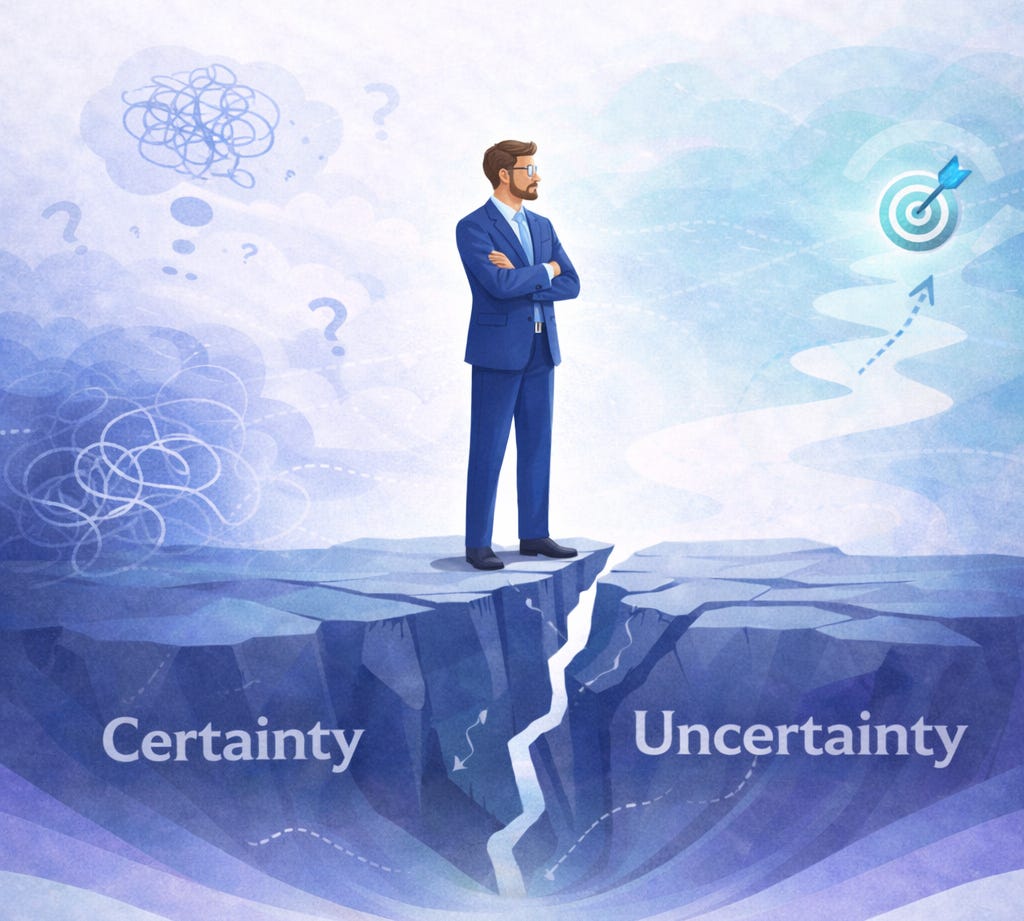
The leadership bind: uncertainty is real, but uncertainty is judged
Senior leaders often live in a bind that is hard to describe.
They are dealing with real uncertainty as part of their role, and they are also being evaluated on how they handle uncertainty publicly.
Løhre and colleagues show that people respond differently depending on how leaders express uncertainty. External uncertainty can be perceived as more competent than internal uncertainty, even if internal uncertainty is perceived as more honest.
This is a subtle but important point.
It means leaders are not only deciding what to do. They are deciding what to reveal. They are thinking about the social consequences of not knowing.
So they carry two loads.
The cognitive load of uncertainty itself, and the relational load of how uncertainty will be interpreted.
It is not surprising that the mind gets busy.
Why seniority can intensify the pressure
As you become more senior, three things tend to increase.
The complexity of decisions.
The visibility of decisions.
The consequence of decisions.
This changes how doubt feels.
In junior roles, uncertainty can be a normal part of learning. In senior roles, uncertainty can feel like exposure, even when it is simply reality.
This is one reason leaders can look confident externally while feeling tense internally. They are holding the weight of consequence while trying to protect the organisation from unnecessary instability.
In the best cases, this becomes calm leadership. The leader holds the uncertainty without spreading it.
In the worst cases, it becomes certainty theatre. The leader performs answers to reduce discomfort, then deals with the consequences later.
Why people prefer a wrong answer to no answer
Many teams say they want honesty. Many cultures say they value transparency.
Then uncertainty appears, and people react differently.
They want closure. They want speed. They want the discomfort removed.
So the leader learns what is rewarded.
You can see this in meeting dynamics. The person who speaks first can set the frame. The person who speaks with certainty can dominate the decision. The person who says “I’m not sure” can be subtly sidelined.
This is not because people are cruel. It is because ambiguity is emotionally uncomfortable, and many cultures lack the skill of holding it.
This is also why some leaders become addicted to certainty. It gives relief. It gives status. It reduces challenge.
It also creates fragility, because real leadership is filled with unknowns.
What experienced leaders develop instead
The myth is that experienced leaders have all the answers.
In practice, experienced leaders often develop something different.
They develop tolerance for uncertainty. They develop emotional stability. They develop the ability to hold questions without panicking.
They also develop a different relationship with identity.
Instead of anchoring identity in “always knowing,” they anchor it in judgement, responsibility, and steadiness. They become comfortable being the person who can carry uncertainty without collapsing into it.
That is a quieter kind of confidence. It is not always charismatic. It is often more trustworthy.
This is where the focus shifts.
From having the answer, to understanding the question.
From looking certain, to being able to think clearly under pressure.
From proving competence, to staying aligned with values while deciding.
A calmer way to hold the pressure
If you feel the pressure to have it figured out, it might help to name what is happening.
This pressure is not only about you.
It is partly social conditioning, partly identity, and partly the psychology of uncertainty.
Overthinking, in this context, is often information. It is your system trying to close loops in a world that does not always offer closure.
The work is not to eliminate uncertainty. The work is to stop treating uncertainty as disqualification.
Because leadership does not require omniscience.
It requires steadiness while you do not yet know.
A question worth holding is simple.
Where, in your life, have you mistaken certainty for competence, and what has it cost you?