
Most leadership development conversations focus on skills.
How to delegate. How to influence. How to run meetings. How to manage conflict.
Skills matter, but they are not the whole story.
A quieter, more destabilising part of leadership is identity. Not identity as a brand, but identity as a lived sense of who you are being in your role, and what you believe you are responsible for.
This is why leadership can feel strangely unstable during promotions. You can be performing well and still feel internally unsettled, because the role has changed faster than your identity has updated.
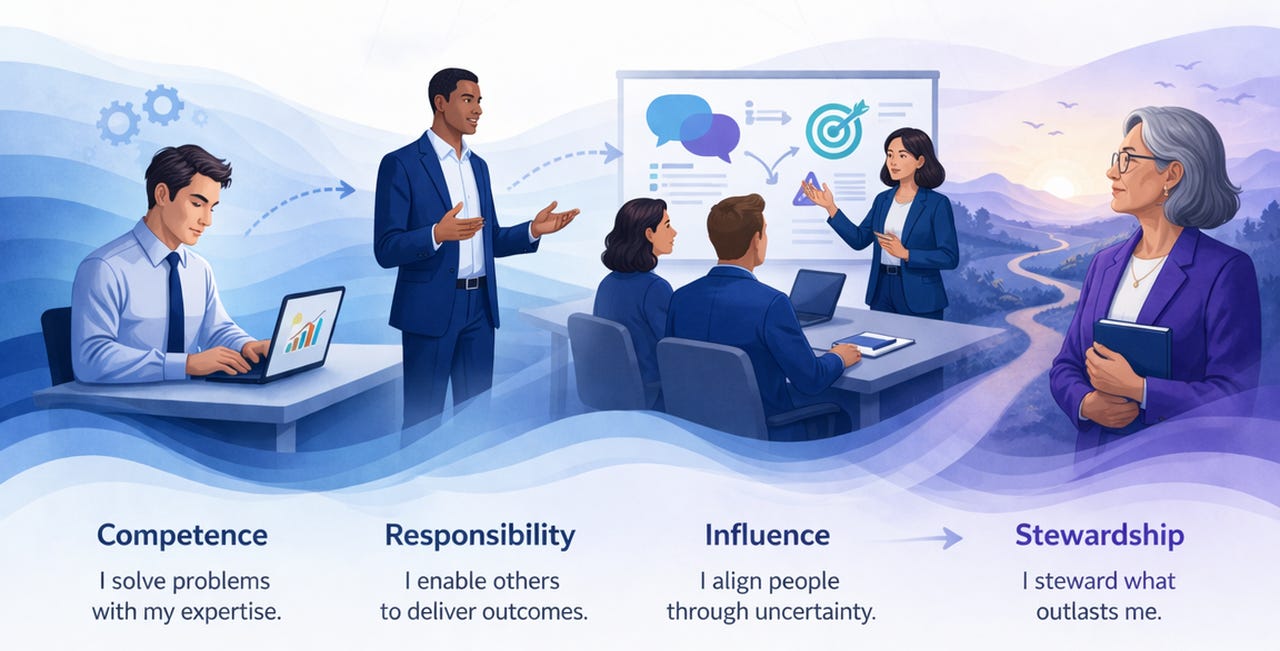
Leadership identity tends to evolve through distinct shifts across a career. Real careers are not linear, and people move through these stages in their own order, and sometimes revisit them. Still, there is a pattern that many leaders recognise when it is named.
Competence. Responsibility. Influence. Stewardship.
Each stage is less about becoming “better” and more about becoming different.
Stage one: competence
Early career leadership identity is often built on personal competence.
You become known for being capable. You solve problems. You deliver results. You are relied on because you know things and can do things.
This is a clean identity. It is measurable. It is rewarded. It also makes sense in environments where performance is visible and feedback is frequent.
Many leaders stay psychologically attached to this stage longer than they realise. They keep trying to lead through expertise, even when the role has already moved beyond it.
When this stage is overused, it often looks like overworking, micromanaging, or stepping in to rescue, not because the leader does not trust others, but because their identity is still anchored in “I am valuable when I personally deliver.”
Stage two: responsibility
Then the role shifts. You lead a team, or a function, or a programme. You are responsible for outcomes that depend on other people.
This is where leadership identity often gets shaky.
You are no longer the person producing every outcome directly. You are the person creating the conditions for outcomes. That can feel like a loss, even when it is a promotion, because the work is less tangible.
Some leaders experience this as leadership shock. The old identity was clear. The new one feels vague. They can feel oddly fraudulent, not because they cannot lead, but because the previous source of confidence has disappeared.
The identity challenge here is simple to name, even if it is hard to live.
You are moving from “I solve problems” to “I enable others to solve problems.”
For many capable people, this is the first time they have to let go of control while still being accountable. It is also where impostor feelings often appear, because your internal story has not yet caught up with the new reality.
Stage three: influence
As you move into senior roles, leadership becomes less operational and more relational.
You spend more time aligning stakeholders, navigating competing priorities, and holding decisions that affect larger systems. The work becomes about judgement and perspective. You are paid to see what others cannot see, and to hold what others cannot hold.
This is where the “authority gap” often appears.
You might be responsible for outcomes you cannot fully control. You might be leading people you do not manage directly. You might be accountable for decisions that require buy-in from peers, boards, or partners.
So leadership becomes influence rather than authority.
If you are still trying to lead from the competence identity, this stage will feel exhausting. You cannot out-expert your way through stakeholder politics. You cannot solve your way out of every trade-off.
This is also where mental load increases. The time horizons get longer. The consequences get wider. Your decisions are interpreted, not only implemented. The pressure of visibility rises.
The identity anchor shifts again. It moves from “Can I do this?” to “Can I align people through uncertainty?”
Stage four: stewardship
For many leaders, a later stage emerges that feels different in tone.
The focus becomes long-term impact. Culture. Legacy. Mentorship. The health of the system.
The questions change.
Not “How do we win this quarter?” but “What am I building that lasts beyond me?”
Not “How do I prove myself?” but “What do I want to be responsible for now?”
This stage can arrive with relief, and it can also arrive with discomfort. It often asks leaders to detach from the adrenaline of performance and reattach to meaning.
This is where leaders sometimes face the meaning question. The role is senior, the outcomes are strong, and yet something feels hollow. They realise achievement is not the same as alignment.
Stewardship is not softer leadership. It is often more demanding, because it requires restraint, patience, and a deeper relationship with identity.
Why transitions feel like crises
If this evolution is so common, why does it feel so personal when it happens?
Because each shift asks you to let go of the identity that got you promoted.
Competence got you recognition, so you keep clinging to competence.
Responsibility asks you to trust others, so you feel anxious because you cannot control everything.
Influence asks you to lead without certainty, so you feel exposed because expertise no longer protects you.
Stewardship asks you to care about what outlasts you, so your previous measures of success start to feel thin.
These are not failures. They are identity transitions.
Research supports that leadership identity is not simply a private belief. DeRue and Ashford describe leadership identity construction as a social process of claiming and granting. That helps explain why transitions feel unstable. You are not only changing internally. You are renegotiating how you are recognised in relationship with others.
Lord and Hall also frame leadership skill development as tied to identity development. The deeper the identity, the more the leadership skill changes in quality. This supports the idea that your old strategies can stop working, not because you are regressing, but because the work is asking for a different self.
The hidden moment many leaders dread
There is a later transition that is less talked about.
The title separation moment.
It can happen through leaving a company after a long tenure, stepping down, changing careers, or retiring. When identity has been fused with role, the role’s disappearance can feel like a loss of self.
This is why it matters to build identity that can travel. Titles are temporary. Contribution can remain, but the internal anchor has to be broader than the job.
A calmer way to hold your current stage
If you recognise yourself somewhere in this arc, the most useful shift is often not more effort.
It is a clearer reading of what stage you are in, and what identity you are still trying to use to succeed.
Many leaders feel tension because they are trying to win a responsibility stage role with a competence stage identity. Or they are trying to navigate an influence stage role with an expert identity. Or they are trying to enter stewardship while still measuring themselves only through performance.
None of this makes you broken.
It makes you in transition.
Purpose is directional, not fixed. Leadership identity is similar. It evolves as the work evolves.
A question worth holding is simple.
What identity got you here, and what identity is the role asking you to become now?