
There is a moment many senior professionals recognise, and it can be surprisingly unsettling.
You reach a higher level. You have proven yourself. You have earned trust. You are now the person people look to when decisions matter.
And yet confidence does not rise in a straight line.
In fact, for many people, it dips.
They become more cautious. They second-guess more. They feel a new kind of internal tension that did not exist earlier in their career. They ask questions they used to brush off quickly. Am I making the right call? Am I the right person for this? What if I get this wrong?
It is easy to interpret this as a personal issue. Maybe you are losing your edge. Maybe you are not as resilient as you thought. Maybe you have finally been “found out”.
A calmer interpretation is usually more accurate.
Responsibility changes the conditions of confidence.
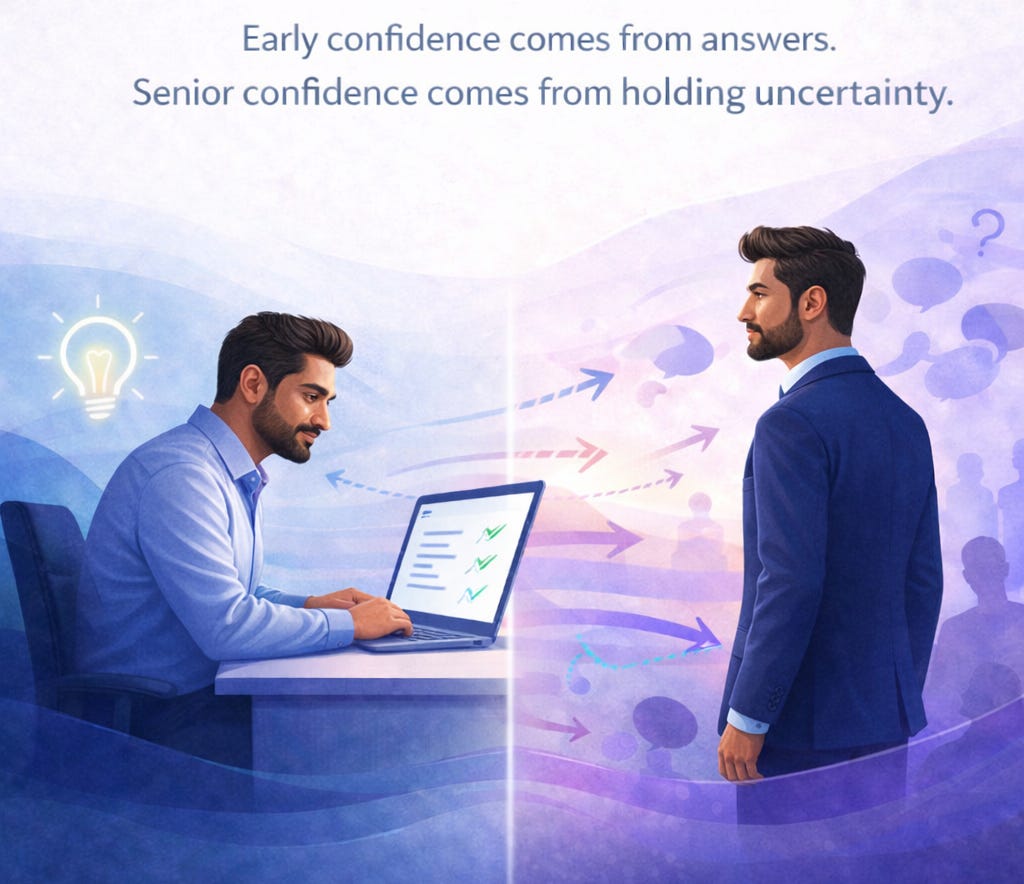
Early confidence is often built on competence
In the early stages of a career, confidence is closely tied to competence.
You learn the craft. You get feedback quickly. Tasks are more contained. Problems have clearer boundaries. You can often see the relationship between effort and outcome.
Even when the work is hard, the structure helps. Someone is overseeing you. Decisions are shared. If you make a mistake, the consequences tend to be local.
That environment makes confidence easier to build, because it provides a steady loop of learning, action, and feedback.
It also gives you something else. It gives you reassurance.
Not reassurance in a sentimental sense. Reassurance in a practical sense. The system itself holds some of the risk.
Senior confidence is built on judgement under uncertainty
As seniority increases, the foundation shifts.
The job is less about executing known tasks and more about holding uncertainty. It is less about doing and more about choosing. It is less about solving problems with clear answers and more about managing trade-offs that have consequences.
This is where confidence becomes harder.
Not because you are less capable, but because the work is less containable.
You are dealing with more variables, and many of those variables are not under your control. You are making decisions with incomplete information. You are balancing multiple stakeholders who want incompatible outcomes. You are holding a longer time horizon, which means feedback is slower and sometimes ambiguous.
If you miss the mark, the consequences are larger. More people are affected. The financial impact can be higher. The reputational impact can linger. The organisational memory can be longer.
It is not surprising that your mind becomes more active. It is trying to protect you from the increased downside.
Senior roles also increase exposure
In senior roles, visibility increases even when you do not seek it.
Your tone is interpreted. Your decisions are analysed. Your presence is noticed. People read meaning into what you say and what you do not say. They also read meaning into what you choose to prioritise.
That exposure changes the emotional load. It adds a performance layer to ordinary moments.
A decision is not just a decision. It is a signal.
A meeting is not just a meeting. It is a test of authority.
Even being calm can be misread as being detached.
When the social stakes rise, the internal commentary often rises too. You start asking if you are coming across the right way. You start noticing your own missteps more sharply. You start rehearsing. You start reviewing.
This is often labelled overthinking.
Sometimes it is.
Sometimes it is simply the mind reacting to a real increase in consequence.
Overthinking can be information.
Competition and politics amplify self-doubt
As you rise, the people around you are often stronger willed. They can also be more invested in status, influence, and control.
In many organisations, seniority involves politics. Sometimes it is subtle. Sometimes it is blatant. Either way, it changes the psychological environment.
You are no longer only assessed on what you do. You are assessed on how you navigate. You are assessed on alliances, relationships, and judgement. You are assessed on strategy and symbolism, not just results.
This can amplify self-doubt because the rules are less explicit. The right move is not always the most rational one. It is sometimes the most socially intelligent one.
That ambiguity can create a new kind of uncertainty. The uncertainty is not about your skill. It is about the system.
The executive role is structurally demanding
It can help to remember that senior roles are not simply “more work.”
There is research that treats executive roles as having distinct job demands, including responsibility load and decision complexity. Hambrick’s work on executive job demands is a useful reference point here. It frames senior leadership as a role with specific pressures that shape behaviour and decision-making.
This matters because it shifts the conversation from personal weakness to structural reality.
If the role is designed around complexity and consequence, then doubt is not a glitch. It is a predictable response.
Sometimes the problem is not that you feel doubt.
Sometimes the problem is that you interpret doubt as disqualification.
Impostor feelings often grow with achievement
Many high achievers experience something that gets described as impostor syndrome. It is the sense of being fraudulent despite evidence of competence.
A systematic review by Bravata and colleagues suggests impostor feelings are common and are associated with stress and burnout, although the research landscape is varied.
The point is not to label everyone with a syndrome.
The point is to normalise that self-doubt can intensify as success grows, because the internal narrative has not always caught up with the external role.
You may have earned the seat. You may simply not feel fully seated yet.
Identity needs to evolve as roles evolve
This is the part that is often missed.
People get to senior roles through a certain identity.
The competent one. The reliable one. The high performer. The person who has it together.
At senior levels, that identity is often insufficient. Not because it is wrong, but because the job now requires something different.
It requires tolerating uncertainty. It requires making trade-offs. It requires holding conflict without needing immediate resolution. It requires being visible without being overly shaped by other people’s reactions.
That is a different identity demand.
If you have not integrated that shift, your internal story can remain stuck in an earlier model of confidence. Confidence then becomes associated with certainty, speed, and being right.
Senior leadership does not always allow for those conditions.
So self-doubt increases, not because you are getting worse, but because you are being asked to operate in a more complex reality with an identity that has not fully adapted.
A healthier question than “How do I eliminate self-doubt?”
Many leaders ask how to remove self-doubt.
That question makes sense, but it can be unrealistic. It can also create unnecessary self-criticism.
A more helpful question is often this.
How do I relate to doubt without letting it take over the whole room?
Doubt can be a signal that you are aware of complexity. It can be a sign you are taking consequence seriously. It can be a sign you understand what you do not control.
That awareness is not weakness.
It is part of mature judgement.
The goal is not to become fearless. The goal is to become coherent. To be able to act while holding uncertainty, because you trust your process and your values even when the outcome is not guaranteed.
That is confidence at senior levels. It is less about certainty. It is more about steadiness.
Calm is a strategic advantage at this level
When responsibility rises, urgency rises with it. Many senior professionals respond by speeding up. They try to think faster. Decide faster. Do more.
This is where calm becomes a strategic advantage.
Calm does not mean inaction. Calm means you can stay in contact with what is true. It means you can process information without becoming emotionally hijacked by it. It means you can hold the pressure without spreading it.
Calm also supports autonomy. It gives you enough internal space to choose rather than react.
When your nervous system is regulated, your decisions tend to be more aligned with your values. When your nervous system is overloaded, your decisions tend to be more shaped by fear and reputation management.
A closing reflection
If your confidence has dipped as responsibility has risen, it may help to interpret it differently.
You are not necessarily regressing.
You may be meeting the reality of what seniority actually is.
More ambiguity. More consequence. More exposure. Less feedback. More trade-offs. More politics. More responsibility that cannot be fully shared.
It would be strange if that did not change how you feel.
The invitation is not to shame yourself for doubting.
The invitation is to evolve your understanding of what confidence looks like now.
Not certainty. Not perfection. Not being unshakeable.
Steadiness.
The ability to lead without needing the conditions to be simple.